
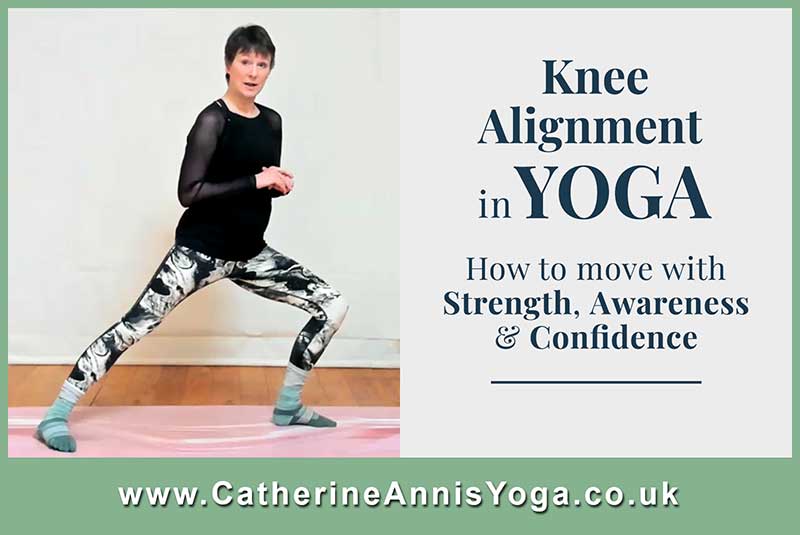
Knee Alignment in Yoga: How to Move with Strength, Awareness and Confidence
When you practise yoga, how much attention do you give to your knees?
You may focus on your breathing, the position of your spine, the movement of your hips or where you place your hands and feet. Your knees, however, can easily be overlooked until a posture feels uncomfortable.
Yet the knees play an important role in many yoga poses. From Warrior II and Chair Pose to lunges, squats, balances and transitions, they help transfer forces between your hips and feet.
.
Understanding knee alignment in yoga can therefore help you develop greater awareness of how your legs move and how different parts of your body work together.
.
However, good alignment does not mean forcing every person's knees into one supposedly perfect position. Bodies vary, poses vary and the demands placed on your knees vary.
A more useful approach to knee alignment in yoga is to understand how the knee moves, how it responds to load and how your hips, ankles, feet and surrounding muscles contribute to that movement.
What Does Knee Alignment Actually Mean?
The knee primarily allows your leg to bend and straighten, although a small amount of rotation and other movement also contributes to normal function.
Importantly, the knee sits between two highly influential areas: the hip above it and the ankle and foot below it. This means the knee does not operate independently.
.
Movement at your hip affects the position of your thigh. Movement at your ankle and foot affects the lower leg. The knee responds to what is happening throughout this connected system.
.
For this reason, knee alignment in yoga should not be reduced to looking at the knee and deciding whether it appears to be in the “correct” place.
Instead, think about the whole leg. Consider where your foot is contacting the floor, how your hip is moving, how much load you are managing and whether you can control the position comfortably.
Why Do Your Knees Matter In Yoga?
Many yoga postures require you to bear weight through your legs.
In standing poses such as Warrior I and Warrior II, your legs support your body while your knees, hips and ankles coordinate the position. In Chair Pose, the knees bend while the hips and ankles also move. During lunges, one knee bends as the opposite leg extends.
Balancing poses create another challenge because the muscles surrounding the knee and ankle contribute to maintaining stability.
Throughout a yoga class, your knees may repeatedly bend, straighten and respond to changes in weight distribution.
.
Developing an understanding of knee alignment in yoga can make these movements feel less mysterious. Rather than treating your knees as fragile joints that must always be protected from movement, you can begin to recognise them as active parts of a larger movement system.
Does Your Knee Always Need To Stay Over Your Ankle?
One of the most familiar yoga instructions is: “Keep your knee directly over your ankle.”
This can be a helpful teaching cue in some positions, especially when someone is first learning a lunge or standing posture. But it is not a universal rule.
.
Your knees naturally travel forwards during many ordinary activities. Think about walking downstairs, sitting into a chair, standing up or squatting to pick something up. Your knees do not remain fixed directly above your ankles.
When considering knee alignment in yoga, the more useful question is not simply whether your knee has moved forwards. Instead, ask whether you can control the movement, whether the load is manageable and whether the position feels appropriate for you.
A yoga cue can provide a useful starting point without becoming a rigid law.
Take a more adaptable approach to knee alignment in yoga and practise with greater confidence
Can Your Knees Move Over Your Toes?
Many people have heard that allowing the knees to move beyond the toes is automatically dangerous. That idea oversimplifies normal movement.
Your knees are designed to bend, and forward knee movement occurs naturally in everyday activities such as climbing stairs and squatting.
Rather than trying to eliminate that movement completely, think about the amount of load involved, your current capacity and whether you have gradually developed the strength to control the position.
This changes the conversation around knee alignment in yoga. Instead of asking whether the knee has crossed an imaginary line above the toes, you can pay attention to how the movement feels and how well you can manage it.
.
The aim is not to avoid normal movement. It is to develop strength, awareness and control through an appropriate range.
How Your Feet Influence Your Knees
Your feet create the foundation for many standing yoga poses.
How you distribute pressure through them can influence movement throughout your legs. If your weight shifts significantly towards one part of the foot, for example, you may notice changes at your ankle, knee or hip.
.
Try standing comfortably in Mountain Pose. Notice the contact between your feet and the floor.
• Can you feel your heels?
• What about the base of each big toe and little toe?
• Now slowly bend your knees and observe what happens.
.
This simple exploration demonstrates why knee alignment in yoga involves more than the knees themselves. Movement travels through your feet, ankles, knees and hips as your body adjusts.
You do not have to force your feet into a perfectly symmetrical position. The exercise is simply an opportunity to notice how your foundation influences the rest of your legs.
How Your Hips Influence Your Knees
Your hip is capable of moving in several directions, while the knee has a more limited range. Because these joints are connected through the thigh, what happens at your hip can affect what you see and feel at your knee.
.
Warrior II provides a useful example. As your front knee bends, your front hip also needs to contribute to the posture. Your pelvis, thigh, knee and foot are all participating in the position.
.
Thinking about knee alignment in yoga as a whole-leg process can prevent you from becoming overly focused on pushing the knee into a specific visual position.
Instead of forcing your front knee outward, consider whether your hip can contribute comfortably. Notice your foot on the floor and allow your knee to bend within a range that you can control.
.
Alignment becomes a coordinated action rather than an isolated correction.

What Does Knee Tracking Mean?
Yoga teachers sometimes encourage students to let the knee “track” in the direction of the toes. Generally, this describes the direction in which the knee moves relative to the foot.
In many standing poses, allowing the knee to broadly follow the direction of the toes can provide a useful starting point. In Warrior II, for example, the front knee commonly points in approximately the same direction as the front toes.
This cue can support awareness of knee alignment in yoga, but it should not become an instruction to force every body into exactly the same shape.
.
Human anatomy varies. People have different proportions, joint structures and movement patterns.
A useful alignment cue should help you explore your movement. It should not require you to fight your anatomy or continue pushing into a position that feels uncomfortable.
What If Your Knee Moves Inward?
You may also have heard the instruction: “Don't let your knee fall inward.”
.
This can be helpful when drawing attention to how the leg is moving, particularly if someone is having difficulty controlling a position.
However, inward movement should not automatically be labelled as dangerous.
The body can move through many different positions. What matters is your ability to manage those positions and respond appropriately to the demands being placed on you.
.
When exploring knee alignment in yoga, notice whether your knee repeatedly moves inward during a posture and whether you feel stable and comfortable. Then consider what is happening elsewhere.
Can your foot remain supported? Is your hip contributing? Can you reduce the depth of the pose and gain more control?
This approach encourages curiosity instead of fear.
.
Yoga Can Help You Build Stronger Legs
Yoga is often associated with flexibility, but many postures also require muscular strength.
Warrior poses challenge the legs as they support your body. Chair Pose requires your quadriceps and gluteal muscles to work. Bridge Pose involves the hips and legs, while standing balances challenge the muscles around the ankles and knees.
.
Strength is an important part of knee alignment in yoga because alignment is not simply about where a joint appears to be. It also involves your ability to control movement.
Your quadriceps contribute to straightening the knee. Your hamstrings help with knee movement and control. Your calf muscles influence the ankle and lower leg, while your gluteal muscles contribute to hip movement.
These muscles work together rather than operating as separate systems
Learn the principles of knee alignment in yoga and start making more informed choices on the mat
Why Strength And Control Matter
It can be tempting to think about the knee as something that needs to be carefully protected by keeping it in one ideal position. A more adaptable perspective recognises that the knee is part of an active system designed to move and respond to load.
.
Building strength can improve your ability to control that movement.
This is one reason knee alignment in yoga should include more than visual instructions. Two people may appear to create a similar pose while experiencing very different levels of effort, stability and control.
Instead of focusing only on appearance, notice what you can feel.
Are your leg muscles working? Can you enter and leave the pose smoothly? Can you breathe comfortably while maintaining the position?
.
Those observations provide useful information about how you are managing the posture.
Knee Alignment In Warrior II
Warrior II is one of the poses in which the position of the front knee receives considerable attention.
As you bend your front knee, allow it to move broadly in the direction of your toes. Keep your front foot grounded and notice how your hip, thigh, knee and ankle work together. Rather than pushing the knee outward as far as possible, explore a position you can control.
.
This is a practical way to approach knee alignment in yoga without trying to reproduce an idealised photograph.
Your front thigh does not have to become parallel with the floor. If going deeper creates discomfort or causes you to lose control, reduce the bend.
A shallower Warrior II is still Warrior II.
.
Depth is not automatically a measure of how well you are performing the posture.
Knee Alignment In Lunges
Lunges place different demands on the front and back legs.
Your front knee bends while the back leg extends, and your front foot helps create a stable base from which to move. Instead of becoming preoccupied with whether the front knee crosses the toes, lower yourself gradually and observe how the entire leg responds.
.
Good knee alignment in yoga during lunges involves awareness of the foot, ankle, knee and hip rather than policing one joint.
Can you maintain contact through your foot? Can you control the movement as you lower? Does the position feel manageable?
If you experience discomfort, decrease the range, adjust your stance or use support.
.
You can also explore different foot positions to discover what allows you to move with greater comfort and control.
Knee Alignment In Chair Pose
Chair Pose provides an excellent opportunity to observe how the knees behave when both legs bend simultaneously.
As you bend your knees and move your hips, the knees naturally travel forwards to some degree. That movement is not automatically a problem.
.
When exploring knee alignment in yoga in Chair Pose, focus on controlling the descent and noticing how pressure is distributed through your feet.
Rather than deliberately pushing your knees backwards because you are worried about them passing your toes, choose a depth that feels strong and manageable.
Notice your breathing as well. If you are gripping, straining or losing your sense of control, coming slightly higher may allow you to practise the pose more effectively.
.
The deepest version is not necessarily the most useful version.

Knee Alignment In Squatting Poses
Squatting is a coordinated movement involving multiple joints. Your knees bend, your hips move, your ankles adjust and your trunk responds to keep you balanced.
Yoga squats provide an opportunity to explore this relationship. When considering knee alignment in yoga during a squat, avoid focusing exclusively on where the knees appear relative to the toes.
Instead, notice whether your feet remain supported and whether your ankles and hips can contribute to the movement.
If a deep squat is difficult, you do not have to force yourself towards the floor. You might reduce the depth or place a block beneath your sitting bones for support.
.
Changing the pose to suit your current capacity is not avoiding the practice. It is part of practising intelligently.
Your Ankles Are Part Of The Picture
Ankle movement can have an important influence on what happens higher up the leg.
When you squat or bend deeply into a standing pose, your ankles need to adjust as your knees and hips move. If ankle mobility is limited, your body may use another movement strategy to achieve the posture.
This demonstrates another important principle of knee alignment in yoga: something that appears to be happening at the knee may be influenced by another part of the body.
Rather than immediately trying to “correct” the knee, look at the wider movement.
What is happening at your foot? How much can your ankle move? What is your hip doing? Can changing the depth of the posture make the movement more comfortable?
.
The body works as a connected system.
Avoid Forcing Your Knees Into Position
Alignment instructions can be useful, but they should not encourage you to force your body into a shape. If moving your knee according to a particular cue causes discomfort, pushing harder is unlikely to be a useful response.
Instead, adapt.
You might reduce the depth of the posture, change your foot position, use a block or chair, or choose a different variation.
.
A healthy approach to knee alignment in yoga should encourage exploration rather than fear of getting something wrong.
Yoga poses are tools, not tests.
You do not have to make your body match somebody else's shape for a posture to be worthwhile.
Improve your understanding of knee alignment in yoga and bring more awareness to every pose
Anatomy Affects How Your Poses Look
Every body has its own proportions and structural characteristics.
Differences in the relative lengths of your thigh and lower-leg bones can influence how a squat looks. Your pelvis can affect how your hips move. Your foot structure and ankle mobility can also influence your standing positions.
This is why knee alignment in yoga cannot be judged entirely by comparing yourself with another person. Two students may perform the same posture with slightly different foot positions or knee angles while both feel stable and controlled.
Alignment should make sense for your anatomy.
This does not mean that technique is irrelevant. It means that useful technique takes individual variation into account rather than assuming everyone should create an identical shape.
Develop Body Awareness Instead Of Chasing Perfection
One of yoga's most useful qualities is the opportunity it gives you to pay attention to your body.
.
Instead of automatically obeying every instruction, notice what happens when you move.
• Where is your weight distributed?
• Can you feel your feet against the floor?
• Does your knee move comfortably?
• Are your toes gripping?
• Can your hips contribute?
• Can you breathe naturally?
• Do you feel stable?
.
These questions create a more practical understanding of knee alignment in yoga than simply trying to copy a picture.
Visual alignment can provide information, but your internal experience matters too.
.
Learning to notice changes in pressure, effort, balance and comfort can help you make more appropriate decisions about how deeply to enter a posture and when to modify it.
Pain Does Not Mean You Have Failed At Alignment
Yoga can involve muscular effort, fatigue and stretching sensations. These experiences are different from sharp, severe or persistent pain. If a movement causes knee pain, do not assume that you simply need to find the “perfect” alignment and push through.
.
When practising knee alignment in yoga, discomfort is information worth paying attention to.
Reduce the range or stop the movement that is causing pain. You can then explore whether another variation feels more comfortable.
If symptoms persist, become worse or follow an injury, seek appropriate professional advice.
.
A yoga teacher may be able to help you adapt a posture, but diagnosing the cause of knee pain is outside the role of a yoga class.
Use Props To Adapt Your Practice
Props can change the demands of a posture and make movement more accessible.
A yoga block can provide support in a squat or standing pose. A folded blanket can cushion your knees during kneeling positions. A wall can provide additional balance, while a chair can reduce the demands of some standing movements.
Using props does not mean you are doing an inferior version of yoga.
In fact, props can help you explore knee alignment in yoga while choosing an amount of load and range that suits your current needs.
Think of them as tools that give you more options.
.
The goal is not to prove that you can perform every posture without assistance. The goal is to create a practice that allows you to move, learn and develop appropriately.

What Are The Benefits Of Understanding Knee Alignment?
Learning about knee alignment in yoga can change the way you approach your entire practice.
First, it can improve body awareness. You begin noticing how your feet, ankles, knees and hips interact rather than thinking about each body part separately.
It can also build confidence. Understanding that your knees are designed to move may reduce unnecessary fear around bending, squatting and lunging.
.
Yoga poses can help strengthen the muscles that contribute to leg movement and control. Standing balances can challenge stability throughout the leg, while different variations allow you to adjust the difficulty to your current ability.
Perhaps most importantly, understanding knee alignment in yoga can make your practice more adaptable.
.
Instead of believing there is only one correct version of each pose, you learn to explore options and make decisions based on comfort, control and your individual anatomy.
Try This Simple Knee-Awareness Exercise
Before your next yoga session, try a simple movement exploration.
.
• Stand comfortably with your feet approximately hip-width apart.
• Notice where you feel pressure underneath each foot.
• Without trying to create a perfect position, slowly bend your knees.
• Watch and feel what happens.
• Do your knees travel forwards?
• Do they move slightly towards or away from each other?
• What happens at your ankles?
• Can you keep your feet comfortably grounded?
• How do your hips respond?
• Now slowly straighten your legs and repeat the movement several times.
.
This simple exercise can help you explore knee alignment in yoga without the additional demands of holding a complicated posture.
Try changing the depth slightly and notice whether the movement feels different.
.
The aim is not to identify one perfect pathway. It is to become more aware of how your body naturally coordinates the movement.
Think About Movement, Not Just Position
Alignment is often taught as though the body were a collection of fixed shapes. But yoga involves movement.
You move into poses, hold them for a period and move out again. You transition from one position to another. Your balance changes, muscles respond and joints adapt to changing forces.
.
For this reason, knee alignment in yoga is not only about where your knee is at one moment. It is also about how you arrive there.
• Can you lower into a lunge with control?
• Can you rise from Chair Pose smoothly?
• Can you adjust your Warrior II stance without pain? Can you recognise when you need to reduce your range?
.
These questions shift attention from creating a photographically perfect posture towards developing movement skills.
Let Alignment Cues Remain Flexible
Yoga teachers use cues because they can help students organise a pose and direct their attention.
.
• “Track your knee towards your toes.”
• “Ground through your foot.”
• “Bend your front knee.”
.
Each instruction can be useful, but no short verbal cue can describe every detail of every person's anatomy.
.
A balanced approach to knee alignment in yoga treats cues as suggestions for exploration rather than absolute commands.
Try the instruction. Notice what happens. If it helps you feel stable and comfortable, it may be useful.
If it creates pain, excessive tension or a sense that you are forcing your body somewhere it does not want to go, consider another option.
.
Good teaching leaves room for individual variation.
Build Confidence Through Gradual Practice
You do not need to master your knee position in a single yoga session. Strength, mobility, balance and body awareness develop through practice.
.
Start with ranges that feel manageable. Give yourself time to learn how different postures affect your legs. Notice whether your control changes as you become stronger and more familiar with the movements.
A gradual approach to knee alignment in yoga allows you to build experience instead of chasing immediate perfection.
Some days you may comfortably bend deeper. On another day, a shallower position may feel more appropriate.
Both can be valid choices.
.
Your practice does not have to look exactly the same every time to be valuable.
Final Thoughts
Your knees matter in yoga because they form an important part of the connection between your feet, ankles, hips and pelvis.
But good knee alignment in yoga is not about holding your knees in one rigid position.
Your knees are designed to bend, bear load and respond to movement. They work alongside the muscles and joints throughout your legs and the rest of your body.
That means knee alignment in yoga is better understood as a dynamic process involving movement, strength, control, awareness and individual anatomy.
Instead of repeatedly asking, “Is my knee in the perfect position?”, consider asking different questions.
• Can I control this movement comfortably?
• Does my foot feel supported?
• Can my ankle and hip contribute?
• Can I breathe naturally?
• Can I reduce the range if I need to?
• Do I have another variation available?
.
These questions encourage a more realistic and adaptable approach to knee alignment in yoga.
.
Your body does not have to reproduce a perfect picture. It needs opportunities to move, develop strength and learn.
The more you understand how your knees interact with your feet, ankles and hips, the easier it becomes to make informed choices during your practice.
.
Ultimately, knee alignment in yoga is not about protecting your knees by avoiding movement. It is about developing the strength, mobility, awareness and confidence that allow your body to move well.
Explore knee alignment in yoga in your next practice and notice how your feet, ankles, knees and hips work together
Enjoyed this? Let's stay connected.
Follow me on Instagram for practical movement ideas, strength and somatic yoga, and ideas to help you move well, feel strong and stay resilient.