
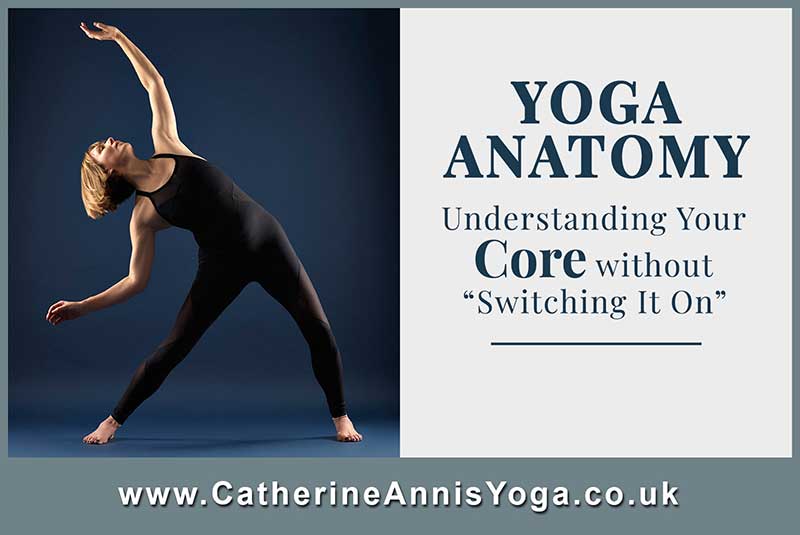
Yoga Anatomy: Understanding Your Core Without “Switching It On”
“Engage your core.” “Draw your navel towards your spine.” “Switch on your abdominals.”
These are familiar instructions in yoga classes, and they are usually offered with good intentions. We want to help students feel supported, protect their backs and create stability. Yet the more closely we look at yoga anatomy, the less convincing the idea of a core that simply needs to be switched on becomes.
.
Your centre is not a single muscle, nor is it a rigid cylinder that must be permanently braced. It is a responsive, adaptable part of a whole-body system involving the diaphragm, abdominal wall, pelvic floor, spine, pelvis, ribs and many other structures. These tissues constantly adjust to breathing, gravity, movement and the changing demands of whatever you are doing.
Understanding this can change the way we practise.
.
Instead of gripping the abdomen before every movement, yoga anatomy invites us to become curious about how support actually arises. We can begin to notice the relationship between breath and movement, how the ground contributes to stability, how the spine responds to load and how the centre organises itself differently when we stand, twist, reach, balance or rest.
The result is not necessarily a “stronger core” in the conventional fitness sense. It can be something more useful: a body that knows how to organise support without unnecessary tension.
What Do We Actually Mean By “The Core”?
The word “core” sounds reassuringly precise, but anatomically it is surprisingly vague.
Ask ten movement teachers what constitutes the core and you may receive ten slightly different answers. Some will point primarily to the abdominal muscles. Others will include the back muscles, pelvic floor and diaphragm. Some definitions extend to the hips, pelvis and even the muscles connecting the trunk with the limbs.
This is one reason yoga anatomy can be so helpful. Rather than treating the core as a mysterious muscular corset, we can look at the actual structures involved and, more importantly, consider how they cooperate.
The abdominal wall itself contains several layers. Rectus abdominis runs vertically along the front of the abdomen and is the muscle responsible for the familiar “six-pack” appearance. The internal and external obliques wrap around the sides of the trunk and contribute to rotation, side bending and the management of pressure. Transversus abdominis lies deeper and encircles much of the abdominal region.
Behind us, numerous muscles support and move the spine. Below is the pelvic floor; above is the respiratory diaphragm. The ribs, pelvis, vertebrae and connective tissues all contribute to the changing shape and mechanical behaviour of the trunk.
But yoga anatomy becomes most interesting when we stop viewing these parts in isolation.
A muscle does not know that somebody has labelled it a “core muscle”. It simply responds within a network. Depending on the task, muscles change their timing, intensity and relationship with neighbouring structures. Support is therefore less like flicking a switch and more like an orchestra continually adjusting its volume, rhythm and emphasis.
Your Core Is Already Working
If you are sitting upright reading this, your core is working.
If you stand up, it works.
If you walk across the room, breathe deeply, reach for a mug, turn to look behind you or laugh, it works.
.
One of the most useful lessons from yoga anatomy is that we do not need to consciously instruct every muscle before it can participate in movement. The nervous system is extraordinarily sophisticated. It continuously receives information about position, load, balance and intention, then coordinates muscular activity accordingly.
This does not mean conscious muscular work is useless. There are times when deliberately creating tension can be informative or necessary. Exploring abdominal strength can be valuable, particularly when we want to increase our capacity to tolerate load.
The problem arises when voluntary gripping becomes our default definition of stability.
.
If every movement begins by pulling the belly in firmly, we may become very good at pulling the belly in. That is not necessarily the same thing as becoming more adaptable, coordinated or strong.
Good yoga anatomy encourages us to distinguish between useful effort and habitual tension.
Stability Does Not Mean Rigidity
Stability is sometimes imagined as the absence of movement. A “stable” spine, in this model, is one that is held firmly in position while the limbs move around it.
Human movement is rarely that simple.
Our spines are designed to move. They flex, extend, rotate and side bend, often combining several of these actions at once. The ribs move with respiration. The pelvis shifts as weight travels from one foot to another. Even when we appear completely still, tiny adjustments continue throughout the body.
From the perspective of yoga anatomy, stability is better understood as the capacity to respond appropriately to change.
.
Imagine standing on one leg. You could attempt to make yourself stable by stiffening everything: gripping the toes, tightening the buttocks, bracing the abdomen, holding the breath and fixing your gaze desperately ahead. You might stay upright, but at considerable energetic cost.
Alternatively, you could allow small movements through the foot, ankle, hip, spine and ribs. The body can sway, receive information and make continual corrections.
This second strategy may look less rigid, but it is highly organised.
Stability is alive.
What Happens When We “Switch On” The Core?
Try an experiment.
Sit comfortably and place a hand over your abdomen. Without changing anything else, deliberately “switch on” your core as strongly as you can.
What happens?
Perhaps your abdomen hardens. Maybe your ribs become less mobile. Your pelvic floor may respond. Your breathing may become shallower, or you may notice tension appearing in your jaw, shoulders or throat.
Now release the effort and breathe normally.
.
This simple exploration illustrates an important principle of yoga anatomy: muscles rarely act in complete isolation. Changing tension in one area influences pressure and movement elsewhere.
There is nothing inherently wrong with bracing. If you were about to lift something extremely heavy, a significant increase in trunk stiffness could be useful. The question is whether the same strategy is necessary when raising an arm in Trikonasana or moving gently from lying to sitting.
Context matters.
A useful body has access to many strategies rather than applying maximum tension to every task.

The Diaphragm Belongs In The Conversation
Discussions about core strength sometimes focus almost entirely on the abdominal muscles, while breathing is treated as a separate subject.
Yoga anatomy tells a much richer story.
.
The diaphragm is a large, dome-shaped respiratory muscle positioned beneath the lungs. When we inhale, it contracts and descends, contributing to changes in pressure and volume within the trunk. The ribs respond, the abdominal contents are displaced and the abdominal wall adapts. The pelvic floor is also part of this dynamic pressure system.
Breathing and support are therefore not separate processes.
This helps explain why aggressively drawing the abdomen inward can alter the quality of the breath. If we hold the abdominal wall rigidly, we change the environment into which the diaphragm is moving.
Again, this does not mean the abdomen should always be completely relaxed. It means its activity needs to be responsive.
.
Exploring yoga anatomy through breathing can help us experience the centre as three-dimensional. Instead of thinking only about the front of the belly, notice movement around the lower ribs, sides of the waist and back of the body.
Breathing is not simply happening in front of you.
The Pelvic Floor Is Not An Isolated Lift
The pelvic floor has also become increasingly prominent in discussions about the core. Unfortunately, it can receive the same treatment as the abdominals: “lift it”, “activate it” or “keep it engaged”.
The pelvic floor is a complex group of muscles and connective tissues forming the base of the pelvis. It contributes to continence, pelvic organ support, pressure management and sexual function, while adapting to respiration and movement.
.
From a yoga anatomy perspective, permanently contracting the pelvic floor makes no more sense than permanently contracting your biceps.
Muscles need the ability to generate tension, but they also need to lengthen, soften and coordinate.
This is particularly important because more effort is not always the solution to a feeling of weakness or instability. A muscle can be both tense and poorly coordinated. Someone who already habitually holds tension may not benefit from being repeatedly told to squeeze harder.
Awareness gives us more choices.
The Abdominal Muscles Are Movement Muscles Too
Another consequence of thinking about the “core” primarily as a stabilising system is that we can forget something obvious: the abdominal muscles help us move.
They participate in flexion, rotation and side bending of the trunk. They contribute to breathing, coughing and changes in intra-abdominal pressure. Their roles vary according to position and task.
Good yoga anatomy restores movement to the conversation.
.
Consider a twist. Rather than bracing the abdomen first and then trying to rotate around that rigidity, what happens if the abdominal wall is allowed to participate in the rotation?
Or consider spinal flexion. Instead of assuming that rounding the spine represents a failure of core stability, can we recognise flexion as one of the movements available to a healthy, adaptable spine?
.
Yoga becomes more interesting when we stop dividing the body into muscles that “stabilise” and muscles that “move”. In reality, these functions overlap continually.
Support Begins With The Ground
If you want to explore your centre, start with your feet.
This may sound strange in an article about yoga anatomy and the core, but support is never purely local.
.
Stand and notice the contact between your feet and the floor. Allow your weight to move slightly forwards, backwards and from side to side. Notice how the rest of your body responds.
As pressure changes beneath the feet, adjustments travel upwards through the ankles, knees, hips, pelvis, spine and ribs. Your centre responds because the whole system responds.
Now press one foot more deliberately into the floor and notice what changes through your trunk.
.
This is a useful reminder that muscular support does not have to begin with an instruction to the abdomen. Sometimes the most effective way to organise the centre is to improve our relationship with the ground.
This principle appears repeatedly in yoga anatomy: function emerges from relationships.
The Limbs And Core Are Not Separate
Raise one arm overhead.
Something happens through your shoulder, obviously, but also through your ribs, spine and pelvis. Depending on how you reach, your weight may shift through your feet. Your breathing may change. Muscles throughout your trunk alter their activity to accommodate the movement.
Now reach the arm further without allowing anything else to move.
The movement probably becomes smaller or more effortful.
Yoga anatomy helps us see why. The arm is not an independent lever attached to a stationary torso. The shoulder blade glides over the ribcage, the ribs relate to the spine, and the movement of the arm can be distributed throughout the body.
The same is true of the legs.
In standing poses, lunges and balances, forces move between the ground, legs, pelvis and trunk. Rather than “switching on the core” and then moving the limbs, we can explore how movement of the limbs itself evokes support through the centre.
This is coordination rather than control.
What About Protecting The Lower Back?
Many core instructions are motivated by a desire to protect the lumbar spine. This is understandable, especially when students have experienced back pain.
Yet yoga anatomy does not support the idea that the lower back must always be held still to remain safe.
The lumbar spine is capable of movement, and ordinary life requires it to tolerate varied positions and loads. Continually avoiding spinal movement can inadvertently reinforce the belief that the back is fragile.
A more useful approach is graded capacity.
.
We can explore how much movement is comfortable today. We can strengthen the trunk in different positions. We can vary load, speed and range. We can notice whether we are holding our breath or creating unnecessary tension.
Most importantly, we can stop treating every sensation as evidence of damage.
.
Yoga anatomy can help teachers offer options rather than rigid rules. Some students may benefit from reducing range or increasing support in a particular movement. Others may discover that allowing more movement actually feels easier.
There is no single “correct” core strategy for every body.
Strength Still Matters
Questioning constant core engagement is not an argument against strength. Quite the opposite.
Strength gives us options. Strong muscles can produce force, absorb load and help us meet the demands of daily life. Maintaining muscular strength becomes particularly important as we age.
An intelligent approach to yoga anatomy can therefore include deliberate strengthening. We might use Plank variations, controlled spinal movements, loaded carries, resistance exercises or other progressively challenging tasks.
The important distinction is between strength and tension. Strength is capacity. Tension is a temporary muscular state.
A person who keeps their abdomen tight throughout the day is not necessarily strong. Equally, a strong person does not need to demonstrate their strength by gripping continuously.
Effective training teaches the body to generate an appropriate amount of force when required and relinquish it when it is no longer useful.
That ability to move between effort and ease is profoundly relevant to yoga.
Exploring Rather Than Correcting
One of the pleasures of yoga anatomy is that it can turn practice into investigation.
Instead of asking, “Am I engaging my core correctly?”, try asking different questions.
.
• What changes if I breathe here?
• Where does the movement begin?
• Can I use less effort?
• What happens through my feet when I raise my arms?
• Can my ribs move while I balance?
• What changes if I soften my jaw?
• How does my spine respond if I stop trying to hold it perfectly still?
.
These questions do not have universal answers. That is precisely why they are useful.
.
Yoga anatomy is not simply information we memorise about muscle origins and insertions. It can become a way of paying attention. Anatomical knowledge provides a framework, while sensation and movement allow us to explore that framework from the inside.
This approach encourages autonomy. Rather than waiting for a teacher to tell us exactly what should be happening, we develop the confidence to notice what actually is happening.
Core Support Changes From Pose To Pose
Think about the enormous variety of demands within a yoga practice.
In Savasana, the trunk can be relatively quiet. In a standing balance, the centre makes constant subtle adjustments. In Plank, it manages substantial load. During a twist, it participates in rotation. In a backbend, the relationship between the abdominal wall, spine, pelvis and breath changes again.
Why would we expect one core instruction to serve all these situations?
.
Yoga anatomy encourages specificity.
In a demanding arm balance, substantial muscular effort may be entirely appropriate. During a gentle supine movement, the same degree of bracing could simply make the experience harder.
We can therefore replace the instruction “keep your core engaged” with something more responsive: discover how much support this movement requires.
Sometimes that will be a lot. Sometimes remarkably little.
Less Effort Can Reveal More Information
Habitual tension can create a kind of background noise.
If we constantly grip the abdomen, buttocks, jaw or shoulders, it becomes difficult to distinguish the muscular responses that arise naturally from movement.
Reducing unnecessary effort can make sensation clearer.
This is where yoga anatomy meets somatic enquiry. Move slowly enough to notice what happens before you intervene. Give the nervous system time to organise a response. Observe where effort appears spontaneously.
.
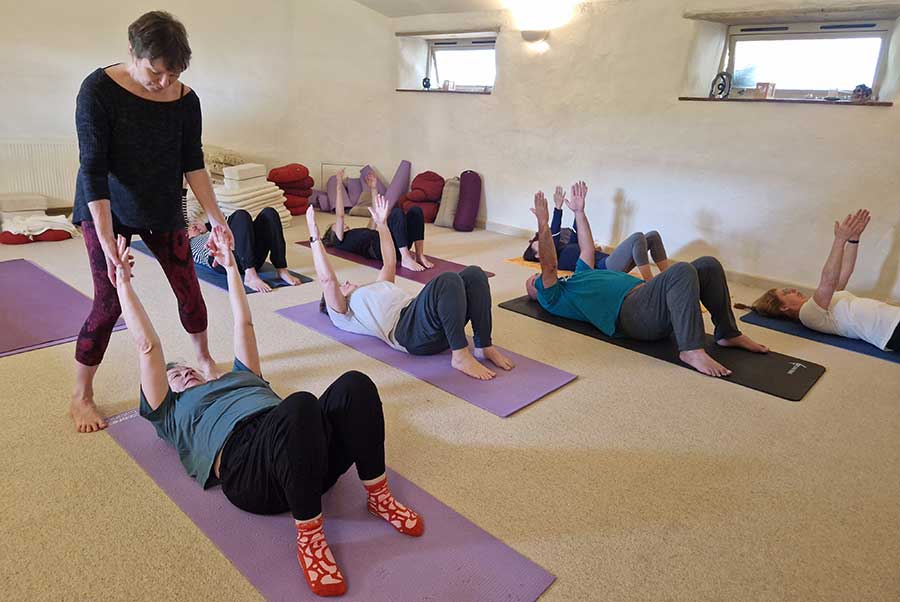
For example, lie on your back with your knees bent and slowly float one foot a few centimetres from the floor. Before deliberately tightening anything, notice what you feel.
.
• Does the abdomen respond?
• Do the ribs change?
• Does the pelvis shift?
• What happens to your breath?
.
Lower the foot and repeat.
Then deliberately brace strongly and try again.
.
Neither version needs to be labelled right or wrong. You are gathering information. That is one of the great benefits of yoga anatomy: it replaces assumptions with curiosity.

Why Language Matters In Yoga Teaching
The words teachers use influence how students understand their bodies.
“Switch on your core” can imply that the core was previously switched off. “Protect your spine” can suggest that the spine is inherently vulnerable. “Lock the pelvis” can encourage rigidity where adaptability might be more useful.
.
An anatomy-informed teacher does not need to eliminate every familiar cue, but yoga anatomy can encourage greater precision.
.
• Instead of “engage your core”, we might say, “Notice what support appears as you press into the floor.”
• Instead of “pull your belly in”, we could explore, “Can you keep breathing while you meet the load?”
• Instead of “keep your spine neutral”, perhaps, “Try this position and notice whether it gives you more space or support.”
.
Language becomes an invitation rather than a command.
This matters because yoga is not merely about producing shapes. It is also a practice through which we learn what to believe about our bodies.
Moving Beyond The Corset Model
The image of the core as a corset is appealing because it is easy to visualise. Yet the living human trunk is much more dynamic.
It changes shape when we breathe. It bends, rotates and extends. Pressure shifts constantly. Muscles lengthen while producing force and coordinate across multiple joints.
.
Yoga anatomy gives us a more generous model: the centre as responsive rather than fixed.
That responsiveness is useful outside yoga too. We need to turn to reach into the back of a car, carry shopping, get out of bed, garden, walk over uneven ground, pick things up and react when we lose our balance.
Life does not happen in perfect alignment.
A resilient body needs experience of variety.
A Different Relationship With The Core
Perhaps the most valuable shift is psychological.
When we are repeatedly instructed to hold, tighten and protect, we can begin to experience the body as something requiring constant supervision. If we stop concentrating for a moment, perhaps something will collapse or become unsafe.
.
Yoga anatomy offers another possibility.
The body is not waiting passively for conscious instructions. It has spent a lifetime organising movement, adjusting to gravity and responding to changing environments. Our task in yoga does not have to be micromanagement.
We can strengthen where strength is useful. We can develop awareness where awareness is lacking. We can challenge ourselves progressively and intelligently. But we can also learn to trust the body's capacity to respond.
.
That does not mean abandoning technique. It means allowing technique to become adaptable rather than rigid.
Let The Core Respond
The next time you hear “engage your core”, pause for a moment before automatically pulling your stomach in.
.
• What is the movement asking of you?
• Can you feel your contact with the ground?
• Are you breathing?
• Does the spine need to be completely still, or could movement be useful?
• Can your ribs respond?
• Could you accomplish the same task with slightly less effort?
.
These questions bring yoga anatomy out of the textbook and into lived experience.
.
Your centre is not one muscle. It is not an on/off switch. And it does not need to remain rigid for you to be safe, capable or strong.
It is part of an intelligent, adaptable whole-body system that responds differently from moment to moment.
Perhaps our practice can do the same.
Rather than trying to hold ourselves together, we can explore what happens when support is allowed to emerge through relationship: feet with ground, breath with ribs, pelvis with spine, limbs with centre, effort with ease.
This is where yoga anatomy becomes more than anatomical knowledge. It becomes a way of listening. And when we listen carefully, we may discover that the core has been responding all along.
Enjoyed this? Let's stay connected.
Follow me on Instagram for practical movement ideas, strength and somatic yoga, and ideas to help you move well, feel strong and stay resilient.