
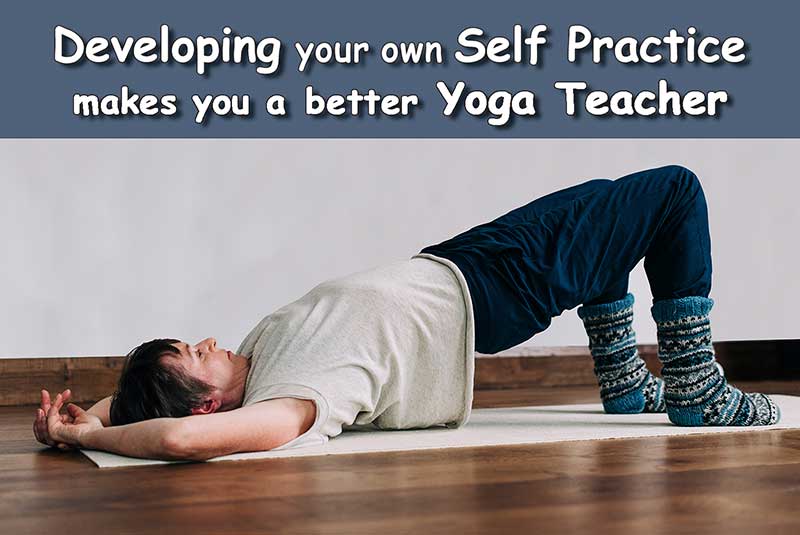
Developing Your Own Self Practice when you become a Yoga Teacher
Teaching begins on the mat at home, with your own self practice.
As yoga facilitators, it's important that we understand and are clear about what we’re asking our bodies to do.
Many of the movements in yoga ask that we position our bodies into extreme positions, right at the end range of many people's flexibility. If we’re serious about practicing and teaching yoga intelligently, it makes sense that we should understand the full complexity of the asanas: both the challenges and the joys of the practice.
The only way to get under the skin of the practice of yoga and to really explore and understand it with authority and authenticity, is to do it yourself - self practice. Through our own self practice, we discover how yoga supports us psychologically and emotionally, as well as physically.
Regarding your self practice, it doesn’t matter what you practice, but it is important that you do practice. It’s important for you to appreciate, from first-hand experience, what you plan to teach in your classes. Therefore, we strongly suggest that you begin your own personal practice immediately and keep a personal journal to record the details of time and content, to refer to later.

Finding Your Own Voice
As you move further and deeper into your own personal understanding of yoga you may find that your approach to self practice becomes more focused, your own voice becomes stronger and that you prefer to work with only a few select individuals.
Eventually, you’ll find yourself teaching completely from your own experience, inspired by your own research and exploration.
.
In the meantime, acknowledge that carving out time for your self practice may be challenging and that you may find it difficult to know how to start, or how to develop your own practice. Common questions that arise are:
• How much time should I spend?
• How often do I need to practice?
• Am I doing it right?
• What should I do next?
• Is it ok to teach what I’ve just learned from another facilitator?
How much time should I spend?
There is no right answer. It depends entirely on you, and how you’re feeling.
How much time do you have?
.
Even 10 minutes each day is a great start. Ideally your practice will fit into your life easily, without creating pressure or becoming overly demanding.
You could begin by approaching just one asana. Open your favourite yoga book, choose one and explore. This is time for you to play, and for your own personal discovery.
How does this movement feel to you?
Do you enjoy it or find it challenging?
How often should I practice?
Consistency is helpful but try to avoid making unrealistic promises to yourself.
If you can find time to self practice a little each day, you will benefit from the gradual layering of your experiences. Your understanding of the movements will deepen and your communication with your whole self – body and mind will improve.
You will begin to experience the benefits of making this regular commitment to your yoga and to yourself.

Making regular self practice accessible
Pushing yourself to self practice every day, for a set amount of time, can make us feel trapped, or resistant.
Yoga practice doesn’t have to mean asana, and it doesn’t have to mean a set amount of time. Rethink your interpretation of “regular self practice” and consider re-framing your understanding of what yoga is.
It may be enough to simply pay attention and look closely at small elements of how you move, consistently, through the day. You could start with the process of walking: the way your thigh bone is suspended from your hip, or the way your body rests upon your feet.
Perhaps you will choose to focus on your wider consciousness, the way you approach living and relating to other beings in the world.
Am I doing it Right?
This is something we all wonder from time to time – and the golden rule is: there are no rules!
Remember to “do no harm”, but beyond that, it’s all up for grabs. Personal practice isn’t for public consumption, so it doesn’t matter if you get stuck, or feel strange – nobody’s watching.
Your practice is private; it’s the time when you work out what feels right for you. If it feels good and makes sense to you, then it probably will for at least a few of those attending the class. Learn to trust your instincts.
The next step is to work out how you will explain what you just did, so that you can explain your process and share your experience with others.
What should I do Next?
You have a couple of choices here. You could either:
• Get off the mat and put the kettle on / go and do something else for a while
• Refer to a book / video / class notes for some inspiration
• Wait until your body suggests something
.
There is no single right way to approach your elf practice and it will inevitably change throughout your life.
.
Tune in to see what’s right for you today.
Be in the moment.
Enjoyed this? Let's stay connected.
Follow me on Instagram for practical movement ideas, strength and somatic yoga, and ideas to help you move well, feel strong and stay resilient.