
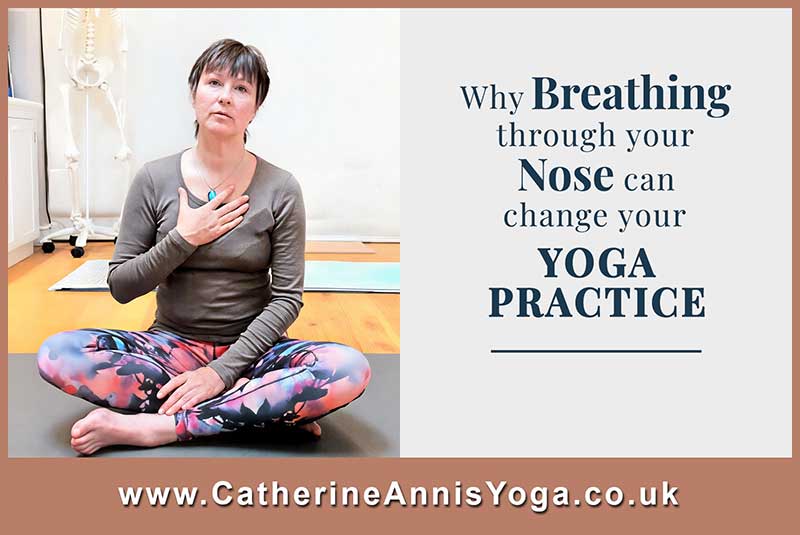
Breathing Through Your Nose: A Simple Way to Transform Your Yoga Practice
Breathing is so ordinary that most of the time we barely notice it.
It accompanies us from our first moments of life to our last, quietly adjusting itself according to whether we are sleeping, walking, talking, exercising, concentrating or resting. Yet in yoga, this apparently ordinary process can become one of our most subtle and revealing teachers.
One particularly interesting place to begin is breathing through your nose.
It sounds almost too simple. Surely, if we are alive and breathing, there cannot be much more to discover? But begin to pay attention and you may notice that the way you breathe changes constantly.
Sometimes the breath is spacious and unhurried. At other times it becomes shallow, rapid or effortful. We sigh, hold our breath, breathe through the mouth, brace the abdomen or lift the shoulders without necessarily realising we are doing any of these things.
.
Yoga gives us an opportunity to become curious about these patterns rather than immediately trying to correct them.
For many people, breathing through your nose can provide a useful starting point. It can encourage us to slow down, sense more clearly and rediscover breathing as a whole-body experience rather than simply an exchange of air.
Why The Nose Matters
The nose is much more than a convenient passageway for air.
As we inhale, the nasal passages help filter, warm and humidify incoming air before it travels further into the respiratory system. The architecture of the nose creates a large internal surface over which the air passes, helping prepare it before it reaches the lungs.
This means breathing through your nose is physiologically different from simply drawing air directly through the mouth.
The nose also creates more resistance to airflow than the mouth. Although resistance may sound undesirable, in quiet breathing it can encourage a more measured movement of air. Rather than gulping in a large breath, we may experience the inhalation as slower and more gradual.
.
From a yoga perspective, this is fascinating because the quality of the breath often influences the quality of our movement.
If breathing is hurried, movement can easily become hurried too. If breathing becomes forced, we may begin forcing the body. When the breath is quiet and responsive, however, we have an opportunity to notice much subtler changes in the ribs, diaphragm, spine, abdomen and pelvic floor.
Breathing through your nose therefore need not be treated as another yoga rule. It can instead become an invitation to listen.
Breathing Is Movement
We sometimes talk about breath and movement as though they were separate things: first we breathe, then we move.
In reality, every breath is already movement.
As you inhale, the diaphragm changes shape and descends. The ribs respond. Pressure changes within the trunk. The abdomen may subtly expand. The spine, shoulders, pelvic floor and surrounding tissues all participate in ways that can be surprisingly complex.
Then the process changes direction.
The exhalation emerges, the diaphragm relaxes upwards and the relationship between the ribs, abdomen and spine changes again.
When we practise breathing through your nose, these movements may become easier to observe because the breath can feel quieter and less dramatic. Instead of trying to manufacture an impressive yogic breath, we can become interested in what is actually happening.
.
Try lying comfortably on the floor and doing almost nothing.
• Notice the incoming breath.
• Where do you first sense movement?
• Does it arrive around the upper chest, side ribs, back ribs or abdomen? Can you feel the floor receiving some of your weight as the breath moves through you?
• hen notice the exhalation.
• There is no need to push it away. See what happens if you simply allow it to leave.
.
This kind of attention can transform breathing through your nose from a technique into an exploration.
The Breath Does Not Need To Be Bigger To Be Better
One of the habits we can acquire in yoga is the belief that a “good” breath must be a very large breath.
A teacher says “take a deep breath in”, and immediately we inflate ourselves as much as possible. The chest rises, the shoulders lift, and the face may tighten with the effort of being extremely good at breathing.
But more is not necessarily better. Sometimes the most useful breath is surprisingly small.
Practising breathing through your nose can help us become sensitive to this. Rather than repeatedly filling the lungs to maximum capacity, we can explore an inhalation that arrives naturally and an exhalation that completes itself without being squeezed out.
.
This can be particularly interesting at the beginning of a yoga practice.
• Lie down. Feel the weight of your body. Notice the places where you meet the ground. Instead of immediately changing anything, spend a few moments observing your breathing.
• Perhaps it is uneven.
• Perhaps one nostril feels clearer than the other.
• Perhaps the breath feels reluctant to move into one side of the ribs.
.
None of this needs to be a problem. The practice begins with noticing.
From Controlling The Breath To Listening To It
There is an important difference between awareness and control.
Yoga contains sophisticated breathing practices, or pranayama, in which the rhythm, duration and pathway of breathing may deliberately be influenced. These practices can be valuable, but breath awareness does not always have to begin there.
Sometimes we learn more by interfering less.
.
When exploring breathing through your nose, try asking questions rather than issuing instructions to your body.
• What happens if I soften my jaw?
• What happens if I stop lifting my chest?
• Can the back of my ribs participate?
• Can I feel the beginning of the inhalation?
• Can I notice the moment when inhalation becomes exhalation?
.
This approach is particularly compatible with Scaravelli-inspired yoga, where practice becomes less about imposing shapes upon the body and more about awakening sensitivity to gravity, breath and the natural responsiveness of the spine.
In that context, breathing through your nose becomes part of a conversation.
• We listen.
• The body responds.
• We listen again.
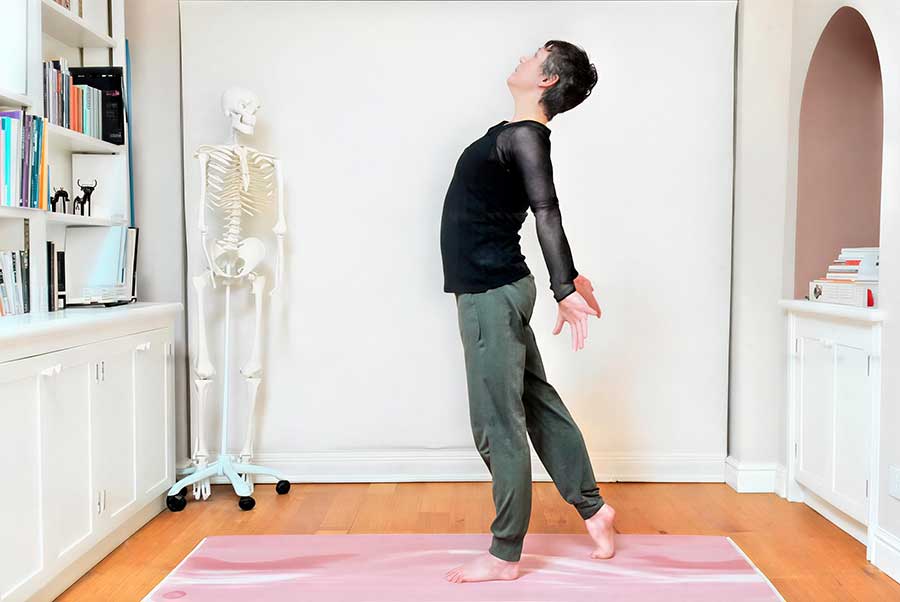
Breath, Gravity And The Spine
One of the qualities I love about Scaravelli-inspired yoga is its invitation to explore the relationship between gravity, breath and the spine.
Gravity is sometimes treated as something we must fight. Yoga poses can then become acts of muscular resistance: holding ourselves up, pulling ourselves into position and trying to maintain the correct shape.
But gravity is also what gives us the ground.
When we allow weight to descend, something else can become available: space, rebound and a sense of upward movement that does not depend entirely upon muscular effort.
.
Breathing through your nose can support this exploration because it gives us a rhythm through which we can notice these changing relationships.
.
Imagine standing quietly.
• Feel your feet.
• Allow your weight to travel down through your legs rather than pulling yourself upwards away from the floor.
• Now notice the breath.
• As the inhalation arrives, can you sense expansion without deliberately lifting yourself?
• As the exhalation leaves, can your weight settle more fully?
• Continue breathing through your nose and notice whether the spine begins to feel less like a rigid column that must be held upright and more like a living, responsive structure.
.
Nothing spectacular has to happen. Often the most significant changes in yoga are quiet ones.
A Natural Doorway Into Slower Breathing
The speed of breathing matters.
When we are frightened, rushing or highly activated, breathing often becomes quicker. When we settle, it commonly becomes slower. The relationship is not perfectly simple, but breath and nervous-system state continually influence one another.
This is one reason slow breathing practices have become an area of considerable interest.
.
For yoga practitioners, however, we do not necessarily need to turn breathing into a numerical exercise.
Breathing through your nose may naturally encourage a quieter pace. You can then become curious about whether the exhalation has time to complete before the next inhalation begins.
.
Try sitting comfortably for a moment.
1. Let the first few breaths be exactly as they are.
2. Then notice whether you can allow each exhalation to become easy and unforced. Do not empty yourself aggressively. Simply follow the breath as it leaves.
3. Wait.
4. The next inhalation will come.
.
There can be something profoundly reassuring about discovering that we do not have to chase every breath.
The Exhalation And Letting Go
In yoga, we often focus on inhalation because it feels expansive and energising. But the exhalation can teach us something equally important.
It is an opportunity to relinquish.
When breathing through your nose, see whether you can follow the whole journey of an exhalation without pushing it. Notice the ribs changing, the abdomen responding and the weight of the body becoming clearer.
• Perhaps the shoulders soften.
• Perhaps the jaw releases.
• Perhaps nothing obvious happens at all.
• Stay interested.
.
At the end of the exhalation, there may be a tiny space before the next breath begins. There is no need to hold the breath or manufacture a pause. Simply notice whether a natural moment of quiet exists.
Then allow the inhalation to find you.
This reverses the common assumption that we must always “take” a breath. Sometimes breath feels less like something we take and more like something we receive.
Nasal Breathing And Nitric Oxide
There is another intriguing aspect of breathing through your nose: nitric oxide.
Nitric oxide is produced within the body, including in the nasal and paranasal sinus region, and has several physiological roles. Air travelling through the nasal passages can carry locally produced nitric oxide onwards into the respiratory tract.
This is one of the reasons nasal breathing has attracted scientific interest.
It is tempting, however, to take an interesting piece of physiology and turn it into an extravagant wellness claim. Yoga does not need that.
.
The human respiratory system is wonderfully complex, and breathing through your nose does not need to be presented as a miraculous cure for everything from poor sleep to low energy.
Its value is interesting enough without exaggeration.
The nose filters, warms and humidifies air. Nasal breathing changes airflow. It may encourage us to breathe more slowly and consciously. And, perhaps most importantly for yoga, it gives us a direct sensory experience through which we can observe ourselves.
Breathing And The Nervous System
We cannot directly instruct the nervous system to “calm down”.
Anyone who has ever been told to relax while feeling stressed knows how ineffective that command can be. But we can create conditions in which settling becomes more possible. Movement, environment, attention, touch, sound and breathing can all contribute to our sense of safety or activation.
This is where breathing through your nose can become useful without turning it into another demand. Instead of saying, “I must calm myself down”, try simply noticing the sensation of air entering the nostrils.
• Is it cool?
• Can you feel where the sensation is strongest?
• What happens as you breathe out?
.
Following these small sensations gives the mind somewhere concrete to rest.
Continue breathing through your nose for several cycles without demanding a particular result.
• You may feel calmer.
• You may not.
• Either response is valid.
.
The aim is not to perform relaxation correctly. It is to develop a more nuanced relationship with your own internal state.
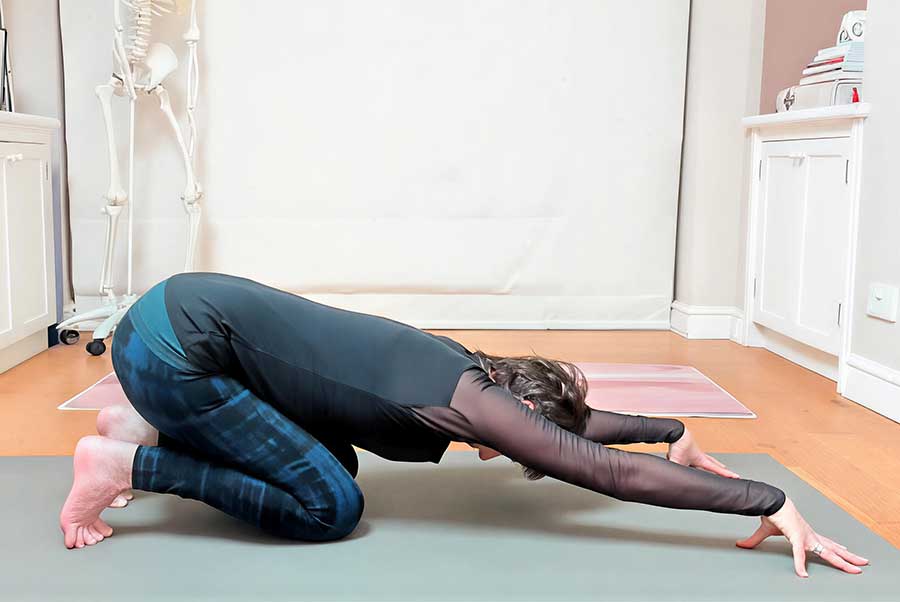
What Happens During Yoga Postures?
Breathing becomes particularly revealing when movement becomes challenging.
You might be comfortable breathing through your nose while lying in constructive rest, but what happens when you move into a standing pose, balance on one leg or begin a stronger sequence?
Suddenly the breath changes. This is useful information. Perhaps you are working harder than you realised. Perhaps you are bracing your abdomen unnecessarily. Perhaps your jaw has tightened or you are holding your breath in anticipation.
.
Instead of interpreting these responses as mistakes, regard them as feedback.
• Try reducing the effort slightly.
• Can you find your feet more clearly?
• Can the spine remain responsive?
• Can you continue breathing through your nose without forcing the breath?
• If not, perhaps the movement needs to change.
.
This is one of the great gifts of breath awareness: the breath can tell us when ambition has overtaken sensitivity.
Breathing Can Help Us Find An Appropriate Level Of Effort
Yoga is not necessarily improved by doing more. We can create impressive shapes while simultaneously losing our relationship with ourselves.
If a posture requires so much effort that the face tightens, the throat grips and breathing becomes strained, it is worth asking what we are actually practising.
Breathing through your nose can function as a quiet measure of effort.
.
This does not mean you must never breathe through your mouth. During vigorous exercise, the body may naturally recruit oral breathing as ventilation requirements increase. Nor should anyone struggle to breathe nasally when congestion or another obstruction makes doing so difficult.
But during comfortable yoga practice, noticing whether breathing through your nose remains easy can help you judge whether the intensity is appropriate for you today.
And “today” matters.
The body you bring to your mat this morning is not identical to yesterday’s body.
There Is No Prize For Perfect Nasal Breathing
This point is important. Yoga can easily become another arena for perfectionism. We learn a new principle and immediately turn it into a rule. Then we judge ourselves for failing to obey it.
Please do not do that with breathing through your nose.
If your nose is congested, breathing through the mouth may be necessary. Structural differences, allergies, respiratory illness and other conditions can all affect nasal airflow. During more strenuous physical activity, oral breathing can also become entirely natural.
.
If breathing through your nose feels uncomfortable or creates a sense of air hunger, do not force it merely because you believe it is the “correct” yogic thing to do.
Yoga should develop sensitivity, not override it.
If nasal obstruction is persistent or breathing difficulties concern you, seek appropriate medical advice rather than attempting to solve the problem through breathing exercises alone.
The Nose As An Anchor For Meditation
One of the simplest meditation practices is also one of the most portable. Feel the breath at the nostrils. That is all. You do not need a mat, candle, special clothing or a quiet room.
When breathing through your nose, notice the touch of the air. The inhalation may feel cooler as it enters. The exhalation may feel slightly warmer. Perhaps one nostril feels more open. Perhaps the sensations change from breath to breath.
.
The purpose is not to analyse every detail. It is simply to return attention to something happening now.
• Thoughts will appear.
• You will remember an email you need to send. You will plan dinner. You will replay yesterday’s conversation.
• Then you notice that attention has wandered and gently return to breathing through your nose.
.
That return is meditation. Not achieving a permanently empty mind. Returning. Again and again.
Breathing Through The Nose In Everyday Life
The most valuable yoga practices are often those that escape the boundaries of the yoga mat.
You might explore breathing through your nose while walking.
Instead of changing your breathing immediately, first notice it. Can you walk at a pace where nasal breathing remains comfortable? What happens when you climb a hill? How quickly does your breathing settle afterwards?
.
You can also experiment while working.
Many of us become almost motionless in front of a screen. The eyes narrow, the head moves towards the monitor, the jaw tightens and breathing becomes barely perceptible.
• Pause
• Feel your feet.
• Look away from the screen.
• Notice breathing through your nose for three or four cycles.
.
That tiny interruption can be a form of yoga. Not because it is dramatic, but because yoga is fundamentally concerned with awareness and relationship.

Try This Simple Breath-Awareness Practice
Lie on your back with your knees bent and your feet resting comfortably on the floor. If lying down is unsuitable, sit somewhere supported.
• Allow yourself a minute to arrive.
• Feel the places where your body meets the ground or chair.
• Begin by observing breathing through your nose without changing its rhythm.
• Notice the inhalation arriving.
• Feel where movement occurs.
• Notice the exhalation leaving.
• After several breaths, bring your attention towards the back of the ribs. You do not need to “breathe into” them. Simply wonder whether movement can be felt there.
• Continue breathing through your nose and allow the jaw, tongue and throat to remain as soft as possible.
• Now become interested in the exhalation.
• Can it leave without being pushed?
• At the end of the exhalation, wait without deliberately holding your breath. Allow the next inhalation to appear when it is ready.
• Spend several minutes like this.
• Then let go of the exercise entirely.
• Notice how you feel.
.
The effect may be obvious, subtle or apparently non-existent. All are useful observations.
Bringing Breath Into Movement
Once you have explored breathing at rest, introduce a simple movement.
.
Lie comfortably with the knees bent. As you continue breathing through your nose, slowly allow one knee to move a little away from the midline and then return. Do not coordinate the movement deliberately with inhalation or exhalation at first. Instead, notice what your breathing does.
• Does it stop as the leg moves?
• Does the movement become easier during one phase of the breath?
• Can the pelvis remain responsive rather than rigid?
• Repeat on the other side.
• Then perhaps allow one arm to travel overhead and return.
• Keep breathing through your nose and notice how the ribs, shoulder blade and spine respond.
.
This is where breath awareness becomes deeply interesting. The breath is no longer something layered artificially on top of movement. It becomes part of the movement itself.
From Technique To Relationship
There are countless breathing techniques available today. Some are traditional yogic practices; others come from sport, rehabilitation, meditation or contemporary breathwork.
.
Techniques can be useful. But underneath every technique is something more fundamental: our relationship with breathing.
• Can we notice without immediately interfering?
• Can we distinguish effort from ease?
• Can we recognise when a breathing practice feels nourishing and when it feels stressful?
• Can breathing through your nose help us become more sensitive rather than more controlling?
.
These questions matter because yoga is not simply about acquiring techniques. It is about becoming more available to experience.
The breath offers us that opportunity every few seconds.
A Quieter Kind Of Yoga
Modern life tends to reward intensity. More steps. More productivity. Harder workouts. Deeper stretches. Bigger experiences.
.
Yoga can easily become absorbed into the same culture.
But breathing through your nose reminds us that some of the richest experiences are almost invisible from the outside.
• Someone lying quietly on a mat may be discovering profound changes in the relationship between their ribs, diaphragm and spine.
• Someone standing in Tadasana may be noticing, perhaps for the first time, how unnecessary tension interferes with breathing.
• Someone resting after practice may discover that the exhalation can leave without being controlled.
.
None of this photographs particularly well. That is partly its beauty.
Let The Breath Teach You
The breath has been with you throughout every yoga practice you have ever done. It was there during your easiest movements and your most challenging postures. It was present when you felt peaceful, frustrated, distracted, strong, vulnerable or tired.
Learning to notice breathing through your nose gives us another way of listening to that continuous companion. Not because nasal breathing is a magic technique. Not because everyone should breathe through the nose every moment of every day. And certainly not because there is one perfect way to breathe.
Its value lies in what it reveals.
.
When breathing through your nose becomes quiet and comfortable, you may begin to sense the body differently. You may notice unnecessary effort sooner. You may become more aware of the movement of the ribs and spine. You may discover a more patient relationship with inhalation and exhalation.
Most importantly, you may begin to trust that yoga does not always require us to add something. Sometimes it asks us to become quiet enough to notice what is already happening.
An Invitation To Explore
The next time you come to your mat, resist the temptation to begin immediately.
• Lie down or sit comfortably.
• Feel the ground beneath you.
• Notice the weight of your body and the places where you are holding yourself away from support.
• Then become aware of breathing through your nose.
• Do not try to improve it.
• Listen
.
Notice the inhalation appearing and the exhalation dissolving. Feel the small movements spreading through the ribs, spine and abdomen. Let gravity receive you while the breath continues its quiet rhythm.
As you begin to move, keep listening.
.
Perhaps breathing through your nose will remain easy. Perhaps it will change. Perhaps your breath will reveal that you need less effort, a different position or simply a pause.
Follow that information with curiosity. This is where breath becomes much more than a technique. It becomes a way of meeting ourselves. And perhaps this is one of yoga’s most valuable lessons: beneath all the postures, instructions and ideas, there is an extraordinarily intelligent living body already breathing.
Our task is not always to tell it what to do. Sometimes, our practice is simply to listen.
Enjoyed this? Let's stay connected.
Follow me on Instagram for practical movement ideas, strength and somatic yoga, and ideas to help you move well, feel strong and stay resilient.