
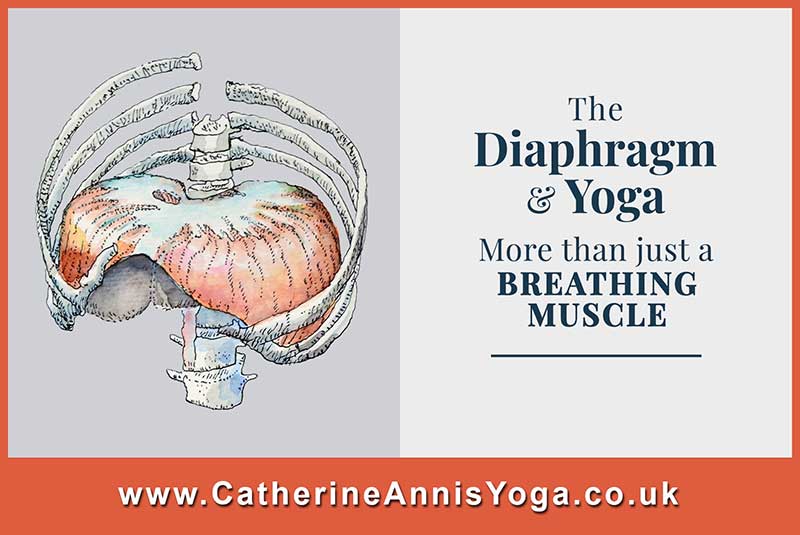
The Diaphragm and Yoga: More Than Just a Breathing Muscle
We tend to think of the diaphragm as a breathing muscle. We inhale, it contracts and descends; we exhale, it relaxes and rises. That is true, of course, but it is only part of the story.
.
When we begin to explore the diaphragm and yoga more closely, a much richer picture emerges. The diaphragm is involved not only in respiration, but also in posture, spinal support, pressure regulation and the subtle coordination between the ribs, abdomen and pelvic floor.
Because breathing accompanies us through every moment of practice, the diaphragm has the potential to influence almost everything we do on the mat.
.
This makes it particularly interesting from a yoga perspective. Instead of treating the breath as something we impose upon the body, we can become curious about how breathing already moves us. We can feel the internal changes created by each inhalation and exhalation and notice how those changes affect balance, strength, mobility and our experience of ourselves.
For me, this is where the diaphragm and yoga becomes fascinating: breath is no longer simply something happening alongside movement. It becomes part of movement itself.
What Exactly Is The Diaphragm?
The diaphragm is a large, dome-shaped sheet of muscle separating the chest from the abdominal cavity. It attaches around the lower ribs, the sternum and the lumbar spine, creating a structure that is much more three-dimensional than we sometimes imagine.
When we inhale, the diaphragm contracts and moves downwards. This increases the space inside the chest and allows the lungs to expand. As the diaphragm descends, the abdominal contents are displaced, which is why a natural breath may create movement not only in the chest but also around the abdomen, waist, back and pelvic floor.
During a relaxed exhalation, the diaphragm releases and rises again.
.
Already, this tells us something important about the diaphragm and yoga. Healthy breathing is not simply a matter of pushing the belly forwards or lifting the chest. Breath involves changes in shape and pressure throughout the trunk.
.
Place your hands around your lower ribs and take a comfortable breath. You may notice movement towards the front, sides and back. Rather than trying to create a large breath, see whether you can simply feel what is already happening.
The quieter you become, the more information becomes available.
Breathing Is Three-Dimensional
Many of us have been taught to think in terms of “chest breathing” or “belly breathing”. These descriptions can be useful, but they can also encourage us to imagine that breathing should happen in one particular place.
In reality, the body is more interesting than that.
.
Exploring the diaphragm and yoga can help us experience breathing as a three-dimensional event. The lower ribs can widen. The back ribs can respond. The abdominal wall can change shape. The pelvic floor can participate in the shifting pressures created by respiration.
This does not mean that every breath must be enormous. Quite the opposite. An obsession with taking deep breaths can create unnecessary effort.
.
Try lying comfortably on your back and noticing your natural breathing without improving it.
• Where do you feel movement?
• Where do you feel very little?
• Does one side of the rib cage respond differently from the other?
.
These observations are not problems to solve. They are information.
One of yoga's great gifts is the opportunity to notice ourselves without immediately deciding that something needs correcting.
Discover Diaphragm and Yoga in Practice - Move beyond theory and explore how your diaphragm responds as you breathe, move and rest
The Diaphragm And The Spine
The diaphragm does not float independently inside us. Its attachments connect it structurally with the lower ribs and lumbar region, while changes in abdominal pressure contribute to the way the trunk manages load.
This is another reason the diaphragm and yoga deserves more attention than it sometimes receives.
.
We often approach spinal stability by deliberately tightening the abdomen. There are situations where muscular bracing is useful, but constantly gripping the belly is not necessarily the same thing as developing intelligent support.
The diaphragm, abdominal wall, spinal muscles and pelvic floor can work together to help regulate pressure through the trunk. When this coordination is responsive, stability can emerge without the sensation of becoming rigid.
.
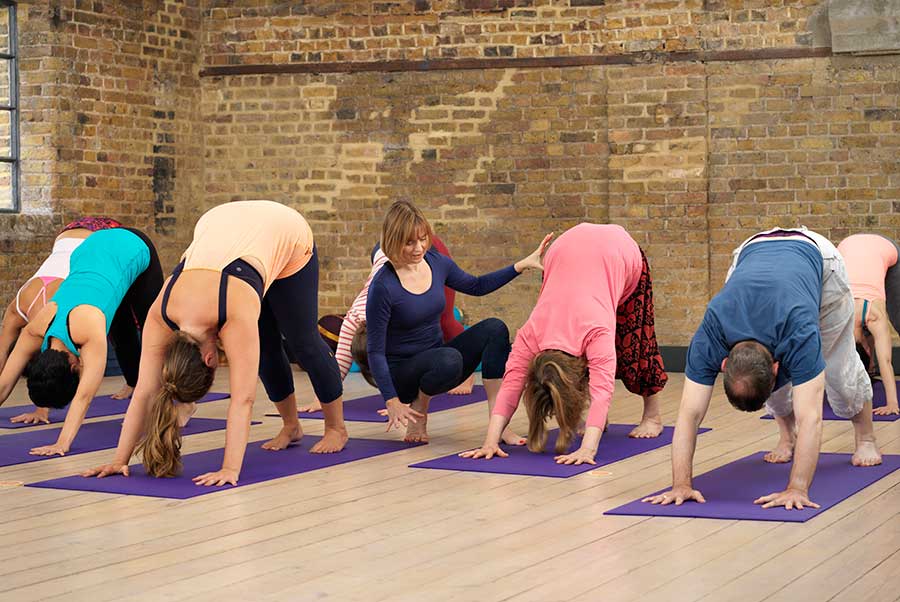
In yoga, we might begin to notice this during transitions.
• What happens as you move from standing into a forward bend?
• What happens when you lift one leg?
• What happens as you come into Plank, Downward Facing Dog or a standing balance?
.
Instead of automatically pulling the abdomen in, experiment with allowing the breath to remain available.
Support does not always have to feel hard.
A Different Way Of Thinking About The Core
The word “core” often conjures images of abdominal exercises, planks and a tightly held waist. But our central support system is far more sophisticated than a single group of muscles.
Thinking about the diaphragm and yoga offers another perspective.
.
The diaphragm forms the upper boundary of the abdominal cavity, while the pelvic floor forms its lower boundary. Around them are the abdominal and spinal muscles. Together these structures respond continuously to movement, load and breathing.
Rather than imagining the core as a corset that needs to be tightened, we might think of it as a responsive container.
It needs firmness sometimes, but it also needs elasticity. It needs to adapt as we twist, bend, reach, walk and breathe.
.
Try standing and deliberately gripping your abdomen as tightly as possible. Notice what happens to your breathing and movement.
Then release the effort and allow a natural exhalation. You may feel the abdominal wall responding without needing to pull it forcefully in.
.
Explorations like these can transform the diaphragm and yoga from an anatomical concept into something directly felt.
The Relationship With The Pelvic Floor
The diaphragm and pelvic floor are separated by the abdominal cavity, but functionally they are closely connected through changes in pressure.
During relaxed inhalation, as the diaphragm descends, the pelvic floor can respond by yielding and moving. During exhalation, both structures can recoil upwards. The movement is subtle, and there is no need to exaggerate it.
.
For yoga practitioners, understanding this relationship can help move us away from the idea that the pelvic floor should constantly be lifted or squeezed.
Within the diaphragm and yoga, the pelvic floor can instead be experienced as responsive tissue: capable of supporting us, but also capable of releasing.
This becomes particularly interesting when exploring bandha. Rather than immediately contracting everything we associate with the pelvic floor or abdomen, what happens if we first become quiet enough to notice the natural response to exhalation?
Perhaps a sense of lift appears without force.
That is a very different experience from holding.
Exhalation And Internal Support
We often give inhalation most of the attention. “Take a deep breath” is probably one of the most familiar instructions in movement and wellbeing.
But exhalation deserves equal curiosity.
.
When investigating the diaphragm and yoga, allowing an exhalation to complete comfortably can reveal an intriguing sense of internal organisation. As the diaphragm rises, the abdominal wall responds and the relationship between ribs, spine and pelvis changes.
This can sometimes create a feeling of lightness or lift through the centre.
Try waiting for an exhalation before moving into a pose rather than automatically inhaling to prepare. Notice whether the movement feels different.
Perhaps you fold forwards on an exhalation. Perhaps you lift a leg as the breath leaves. Perhaps you move into a balance without holding your breath.
.
There is no universal rule that every movement must correspond to a particular phase of breathing. The interesting part is noticing the effect.
In this way, the diaphragm and yoga becomes an investigation rather than a breathing formula.
Breathing And The Nervous System
Breathing is unusual because it happens automatically, yet we can also influence it consciously. That gives it a special place in yoga.
Slow, comfortable breathing can be associated with a quieter physiological state, but forcing ourselves to breathe slowly or deeply does not necessarily produce relaxation.
This distinction matters when exploring the diaphragm and yoga.
.
If we believe there is a “correct” breath we must perform, breathing itself can become another source of effort. We may start dragging air in, controlling the ribs or trying to make the abdomen behave in a particular way.
Instead, begin with observation.
Notice the breath you actually have today.
.
• Is it quick?
• Quiet?
• Uneven?
• Spacious?
• Restricted?
• Does it change after movement?
• Does it change when you lie down?
.
Working with the diaphragm and yoga can become a practice of listening rather than commanding. We create conditions in which breathing may become easier, then allow the nervous system to respond in its own time.
Deepen Your Understanding of the Diaphragm and Yoga - Explore how this remarkable muscle connects breathing with posture, movement and support
Why Posture Affects Breathing
Try slumping deeply forwards and taking a breath. Then gradually allow yourself to become more upright and breathe again.
You will probably notice a difference.
This does not mean there is one perfect posture for breathing. Human beings are designed to move through many positions. But the relationship between our ribs, spine, abdomen and pelvis inevitably changes the mechanical environment in which the diaphragm works.
That is why the diaphragm and yoga cannot really be separated from movement.
.
A side bend changes the shape of the rib cage. A twist changes the relationship between ribs and spine. Back bending creates different pressures from forward bending. Lying on one side changes the effects of gravity.
.
Yoga gives us an extraordinary laboratory in which to explore these relationships.
Instead of asking, “Am I doing this posture correctly?” we might ask, “What happens to my breathing here?”
That question can tell us a great deal.

The Diaphragm In Twists And Side Bends
Twists and lateral movements are particularly interesting because they help us experience parts of the rib cage that can otherwise be difficult to sense.
When considering the diaphragm and yoga, try approaching a side bend without trying to stretch as far as possible.
Raise one arm and gently arc to the opposite side. Pause. Notice the ribs on the more open side and those on the compressed side.
Can you breathe without forcing?
Return to centre and compare sides.
.
In a twist, notice whether you automatically hold your breath as you attempt to rotate further. What happens if you reduce the twist slightly and restore easy breathing?
Sometimes less range produces more internal movement.
.
This is one of the recurring lessons of the diaphragm and yoga: the most visually impressive version of a posture is not necessarily the version that gives us the richest sensory experience.
Balance Begins Inside
Standing balances are usually approached through the feet, legs, eyes and vestibular system, all of which are important. Yet breathing also changes our internal shape continuously.
.
Stand in Tree Pose and notice what happens when you deliberately hold your breath. Then allow yourself to breathe normally.
The movement created by respiration may initially seem inconvenient. Your body has to make tiny adjustments to accommodate it.
But this adaptability is balance.
.
Exploring the diaphragm and yoga in balancing poses reminds us that stability does not mean becoming motionless. Living bodies are always moving.
Your heart is beating. Your blood is circulating. Your ribs are changing shape. Your centre of mass is shifting.
The aim is not to eliminate movement but to become responsive enough to meet it.
This is a much more useful kind of stability, both in yoga and in life.
Can The Diaphragm Become “Tight”?
We often describe muscles as tight, but the sensation we call tightness can have many causes. Breathing habits, stress, prolonged sitting, pain, posture and patterns of muscular effort may all influence how freely the ribs and trunk seem to move.
Rather than diagnosing ourselves, the diaphragm and yoga gives us ways to explore.
.
• Can the lower ribs expand comfortably?
• Can you breathe while lying on your front?
• What changes if you lie on your side?
• Can you exhale without pulling the abdomen forcefully in?
.
Movement can be useful here because the diaphragm does not work in isolation.
Gentle spinal waves, rotations, side bends and changes of position alter the environment around it. Sometimes breathing feels freer not because we have “released the diaphragm” directly, but because the whole body has become more adaptable.
That distinction is important.
Yoga works best when curiosity replaces certainty.
Explore the Connection Between the Diaphragm and Yoga - Experience how breathing can influence your ribs, spine, pelvic floor and whole-body movement
What About Uddiyana Bandha?
Uddiyana Bandha offers a particularly vivid exploration of the diaphragm and abdominal space. Traditionally performed after exhalation, it involves creating an expansion through the rib cage while the breath is held out, drawing the abdominal contents upwards and creating the characteristic hollowing of the abdomen.
In the context of the diaphragm and yoga, this can provide an extraordinary sensory experience of internal space and lift.
However, stronger breath-retention and bandha practices are not appropriate for everyone and are best learnt carefully with experienced guidance, particularly during pregnancy or where there are cardiovascular, respiratory, abdominal or pelvic health concerns.
The goal is not to suck the stomach in as dramatically as possible.
Instead, we can become interested in relationships: ribs widening, pressure changing, tissues responding.
This reflects a broader principle within the diaphragm and yoga. More effort does not automatically create more awareness.
Often the opposite is true.
Stop Trying To Take The Perfect Breath
Yoga students are exposed to many breathing instructions: breathe into the belly, breathe into the ribs, lengthen the exhalation, breathe through the nose, expand the back, engage the abdomen.
Each may be useful in context.
Problems arise when an exploration becomes a rule.
.
One of the most valuable lessons from the diaphragm and yoga is that breathing needs to adapt. The breath required while resting is different from the breath required during a demanding standing sequence. Walking uphill requires something different again.
There is no single breathing pattern we should maintain all day. Instead of pursuing the perfect breath, develop breathing options.
.
• Can you breathe quietly when resting?
• Can your breath become larger when activity demands it?
• Can your ribs move in different directions?
• Can you recover naturally after effort?
.
Adaptability is more valuable than perfection.
A Simple Exploration For Your Practice
You do not need complicated techniques to begin experiencing the diaphragm and yoga.
.
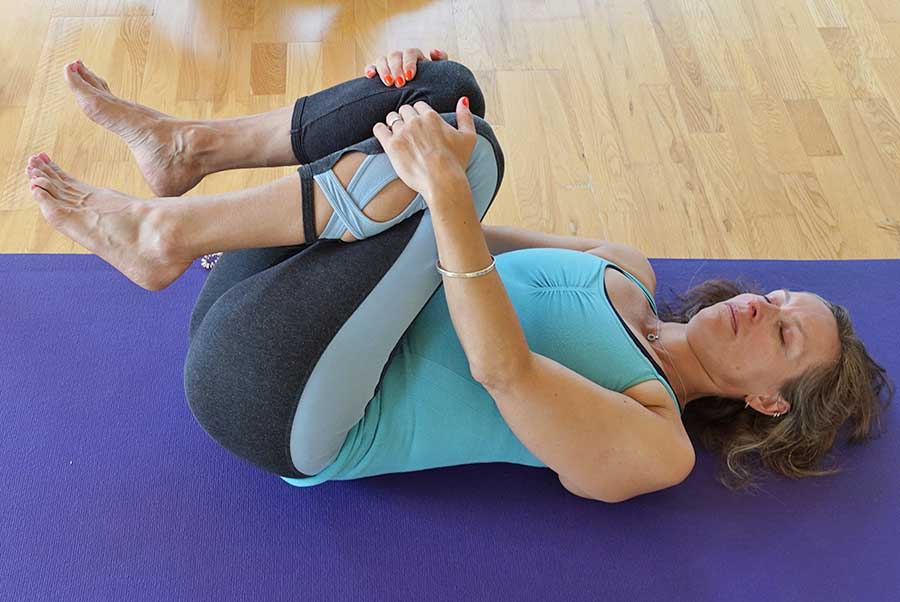
• Lie comfortably with your knees bent and feet on the floor. Give yourself time to settle. Notice where your body meets the ground.
• Place your hands around the lower ribs.
• Do nothing to the breath initially. Simply feel.
• Notice the ribs widening and returning. Sense whether the back of the body moves against the floor. Feel the abdomen respond.
• Then begin a small movement, perhaps allowing one knee to drift gently outwards and return. Does the breath change?
• Roll onto one side and pause again.
• Come onto hands and knees and notice how gravity changes your abdominal wall. Make small, comfortable movements through the spine without deciding when you should inhale or exhale.
• Finally, come to standing.
• Notice your breath before trying to improve your posture.
.
This simple journey demonstrates something central to the diaphragm and yoga: breathing is continually responding to position, gravity, movement and attention.
From Breathing Muscle To Whole-Body Relationship
The more closely we investigate the diaphragm, the harder it becomes to think of it as an isolated breathing muscle.
It participates in a network. That network includes the ribs, spine, abdominal wall, pelvic floor, nervous system and the many tissues that respond to changing pressure as we breathe and move.
.
For yoga practitioners, the diaphragm and yoga therefore offers a route into something much broader than respiratory technique. It gives us a way to explore how the body organises itself from the inside.
• We may discover that strength does not always require gripping.
• We may discover that stability can include movement.
• We may discover that releasing an exhalation creates more space than deliberately pulling ourselves into alignment.
• And perhaps most importantly, we may discover that our bodies are already doing something extraordinarily sophisticated before we interfere with them.
Bringing Curiosity Back To Yoga
It is tempting to approach anatomy as a collection of facts: this muscle does this; that joint moves that way. Anatomy is useful, but living anatomy is far more dynamic.
The experience of the diaphragm and yoga changes from moment to moment.
.
Your breathing today may not feel like your breathing tomorrow. It changes with sleep, stress, activity, mood, position and countless other factors.
Rather than trying to reproduce the same experience every time you practise, yoga can become an opportunity to meet the body that is actually present.
This approach encourages autonomy.
You become less dependent on instructions telling you exactly what you should feel and more capable of recognising your own responses.
That does not mean anything goes. Knowledge and skilled teaching remain important. But information from a teacher can be combined with information coming from your own body.
The conversation between those two sources is where practice becomes truly intelligent.
The Diaphragm and Yoga :
More Than Just a Breathing Muscle
Ultimately, exploring the diaphragm and yoga invites us to reconsider what breathing actually is. It is not merely air entering and leaving the lungs. It is a whole-body event involving movement, pressure, sensation and continual adaptation.
The diaphragm responds to how we sit, stand and move. It works alongside the abdominal wall and pelvic floor. Its movement affects the shape of the rib cage and participates in the organisation of the trunk.
.
In yoga, all of this becomes available for exploration. We do not need to manipulate every breath. We can begin simply by noticing.
.
• What moves when you inhale?
• What changes when you exhale?
• Can you remain responsive when a posture becomes more demanding?
• Can strength appear without rigidity?
• Can you wait long enough to feel what the body does by itself?
.
These questions are why I find the diaphragm and yoga such a rich field of practice. What begins as an investigation of one muscle gradually becomes an exploration of the whole person.
Breath connects our inner and outer worlds. It responds to movement and emotion, effort and rest, attention and environment. By becoming more sensitive to those relationships, we may find not only greater freedom in breathing, but also more ease and intelligence in the way we move.
The diaphragm is certainly a breathing muscle.
But in yoga, it can teach us about much more: support without rigidity, movement without force, stability without stillness and, above all, the value of listening closely to the body we already inhabit.
Ready to Explore the Diaphragm and Yoga Differently? - Join me for an intelligent, exploratory practice where breathing becomes something to experience rather than perfect.
Enjoyed this? Let's stay connected.
Follow me on Instagram for practical movement ideas, strength and somatic yoga, and ideas to help you move well, feel strong and stay resilient.